Showing posts with label Fiber Analysis. Show all posts

Thursday, February 9, 2023

CASHMERE AND CAMEL HAIR MANUFACTURERS INSTITUTE’S FALSE ADVERTISING CASE RESOLVED

CCMI and Etsy, Inc. Have Resolved Their Dispute and Look Forward to Collaborating to Protect the Interests of Cashmere Customers, Manufacturers, and Sellers.

BOSTON, MASSACHUSETTS, February 7, 2023 – The Cashmere and Camel Hair Manufacturers Institute (“CCMI”) announced today that its false advertising and unfair competition action in the U.S. District Court for the District of Massachusetts, entitled CCMI v. Etsy, Inc., Case No. 1:22-cv-12242-RWZ, has been finally resolved, avoiding the need for further proceedings in the case.

CCMI’s legal action, filed in the U.S. federal court on December 30, 2022, had challenged the advertising and sale of purported “100% Cashmere” and “Cashmere” garments on Etsy websites in the U.S. and abroad that CCMI had tested and found not to be Cashmere, but rather to be 100% acrylic, polyester, and other synthetic blends.

Fabio Garzena, President of CCMI, said that “CCMI and Etsy have resolved their dispute and look forward to collaborating to protect the interests of Cashmere customers, manufacturers, and sellers.” CCMI has a long history of working to help maintain the integrity of the Cashmere marketplace by providing important information about Cashmere’s value as a high quality luxury fabric, identifying reliable Cashmere testing laboratories and services, and pursuing legal action where appropriate to challenge the mislabeling of purported Cashmere garments and fabric. CCMI’s legal action presented a number of important intellectual property and competition law issues related to the advertising and sale of falsely or misleadingly advertised products over the internet in the international marketplace. CCMI was represented in the action by Robert J. Kaler, a partner in the international law firm of Holland & Knight LLP.

For further information contact: James Coleman, CCMI USA Representative in Boston, MA, at jcoleman@cashmere.org

Wednesday, January 4, 2023

International Trade Group Files False Advertising Lawsuit Against Etsy

Cashmere & Camel Hair Manufacturers Institute alleges that Garments Are Falsely Advertised as “Cashmere” and “100% Cashmere”

BOSTON, MASSACHUSETTS, January 2, 2023 – The Cashmere and Camel Hair Manufacturers Institute (“CCMI”), a U.S.-based international trade group whose members include some of the world’s largest Cashmere fabric and garment manufacturers, has filed a lawsuit against Etsy, Inc. (Nasdaq: ETSY) in the U.S. District Court for the District of Massachusetts seeking to stop the widespread marketing and sale, both in the U.S. and internationally, of garments that CCMI alleges are being falsely advertised and misrepresented as “100% Cashmere” or “Cashmere” when they are actually either 100% acrylic, a much less expensive, petroleum-based, and more flammable fiber, or are a blend of cheaper synthetic or man-made materials such polyester, nylon, or rayon, and minor percentages of wool.

“CCMI’s position is that a consumer has the right to expect that garments advertised on Etsy as “100% Cashmere” or “Cashmere” will not be materially misrepresented in this way, said Fabio Garzena, President of CCMI, “and when it occurs, CCMI and its members, who make some of the finest Cashmere products in the world, suffer real economic harm. Karl Spilhaus, President Emeritus of CCMI, added that “for more than 35 years, CCMI has been fighting to protect the good name and reputation of Cashmere as a fine specialty fiber; this Etsy case is another chapter in that story.

The Complaint in the action, in which CCMI is represented by Robert J. Kaler, Esq. of the international law firm Holland & Knight, LLP, is available at www.cashmere.org, and details CCMI’s efforts to uncover and challenge the alleged false and deceptive advertising under the applicable U.S. federal and state laws. The name of the case is CCMI v. Etsy, Inc., Civil Action No. 1:22-cv-12242 (D. Mass.).

For further information contact: James Coleman, CCMI USA Representative, at jcoleman@cashmere.org.

Thursday, June 16, 2022

AAFA Urges Congress to Allow Digital Labeling for Clothes

On June 9, 2022, the American Apparel and Footwear Association urged Congress to approve legislation to direct the Federal Trade Commission (FTC) to allow for mandated labeling information on clothes to be delivered to consumers through digital labels using different technologies, including but not limited to QR codes. Such legislation would modernize outdated federal regulations to the benefit of consumers.

Friday, April 8, 2022

$5.5 million total FTC settlements with Kohl’s and Walmart challenge “bamboo” and eco claims, shed light on Penalty Offense enforcement

For consumers shopping for textiles for the home, products promoted as made from bamboo are a popular draw. But the FTC says some items advertised by global retailers Kohl’s and Walmart as “bamboo” were actually made of rayon. According to separate FTC settlements, the companies’ misleading representations violated the FTC Act and the Textile Act. In addition, the FTC says Kohl’s and Walmart engaged in greenwashing by making deceptive eco-friendly claims for those products. And even businesses that don’t have anything to do with textiles should take note of these settlements. Why? Because they use the FTC’s revived Penalty Offense Authority to support a $2.5 million civil penalty from Kohl’s and a $3 million civil penalty from Walmart for violating the Textile Act when they were on notice that improper labeling and advertising of textile products could subject them to civil penalties.

The complaint against Kohl’s charges that the company falsely represented that sheets, pillows, bath rugs, and towels advertised as made wholly or in part from bamboo were, in fact, made of rayon. What’s more, the company described them with terms like “sustainable,” “highly renewable,” and “environmentally friendly.” Kohl’s also advertised some of the products online with a “Cleaner Solutions” seal that linked people to a “Sustainability at Kohl’s” webpage describing initiatives suggesting that the company “care[s] about the planet.”

According to the complaint against Walmart, the company also made false bamboo claims in promoting sheets, towels, blankets, and nursing bras. In addition, Walmart marketed the items with phrases like “eco-friendly & sustainable” and “renewable and environmentally sustainable”

So what’s the real story about bamboo? And how does the FTC know that Kohl’s and Walmart were aware of the truth about bamboo before the companies made those deceptive claims to market the products? That’s where the story gets interesting.

As the complaints explain, under the Textile Act and Rules, rayon is the generic name for a type of fiber made from cellulose through a manufacturing process that uses chemicals like sodium hydroxide that are hazardous to the environment. Although the cellulose could come from bamboo fiber, “hazardous air pollutants (HAP) emitted from cellulose products manufacturing operations” include – according to the Code of Federal Regulations – carbon disulfide, carbonyl sulfide, ethylene oxide, methanol, methyl chloride, propylene oxide, and toluene.

If you think back to high school chemistry, sodium hydroxide is also known by some more evocative names, including “lye” and “caustic soda” – facts that belie the “green” impression conveyed by the word “bamboo.”

Under the Textile Act and Rules, ads for products that reference or imply fiber content must disclose the generic fiber names recognized or established by the FTC and can’t misrepresent fiber content. Therefore, marketing materials for manufactured textile products composed, in whole or in part, of regenerated cellulose fiber must use the generic fiber name – in this case, “rayon” or “viscose.”

How can the FTC be so sure that Kohl’s and Walmart knew that? Because the FTC told them in January 2010 Warning Letters sent directly to those companies and others. FTC staff explained in detail why selling rayon products as “bamboo” was against the law. In addition, the letters enclosed a “synopsis” we now call them Notices of Penalty Offenses – expressly stating that the FTC was putting the company on notice that “the failure to correct improper labeling or advertising of textile products could subject the company to civil penalties.”

The complaints against Kohl’s and Walmart charge them with making false or unsubstantiated claims, in violation of Section 5 of the FTC Act. According to the FTC, they misrepresented that the products were made of bamboo and that they provided environmental benefits when, in fact, the rayon manufacturing process uses toxic chemicals and emits hazardous pollutants. The complaints also allege violations of the Textile Act and Rules.

Companies that follow what’s up at the FTC have been wondering how the agency would use its recently revived penalty offense authority. Count III in the Kohl’s and Walmart complaints may help to answer that question. Citing Section 5(m)(1)(B), the FTC alleges the companies had actual knowledge that falsely or deceptively advertising textile products would subject them to civil penalties.

Read more HERE.

Wednesday, December 8, 2021

Cashmere and Camel Hair Manufacturers Institute’s False Advertising Lawsuit Resolved

On December 7, 2021, the Cashmere and Camel Hair Manufacturers Institute (“CCMI”) announced that its false advertising and unfair competition action in the U.S. District Court for the District of Massachusetts, entitled CCMI v. Amazon.com, Inc. and CS Accessories LLC, Case No. 1:21-cv-11872-WGY, has been finally resolved, avoiding the need for a trial that was scheduled to commence in Boston on Tuesday, December 7, 2021.

CCMI’s legal action, filed in the U.S. federal court on November 18, 2021, had challenged the advertising and sale of purported “100% Cashmere” garments on Amazon websites in the U.S. and abroad that CCMI had tested and found to be 100% Acrylic, Polyester, and other synthetic materials. As part of the resolution of the action, a major supplier of many of the garments, defendant CS Accessories, agreed to the entry of a Final Judgment permanently enjoining it from advertising or selling garments of any kind falsely labeled as “Cashmere.”

Fabio Garzena, President of CCMI, said that “CCMI and Amazon have resolved their dispute and look forward to collaborating to protect the interests of Cashmere customers, manufacturers, and sellers.” CCMI has a long history of working to help maintain the integrity of the Cashmere marketplace by providing important information about Cashmere’s value as a high quality luxury fabric, identifying reliable Cashmere testing laboratories and services, and pursuing legal action where appropriate to challenge the mislabeling of purported Cashmere garments and fabric.

CCMI’s legal action presented a number of important intellectual property and competition law issues related to the advertising and sale of counterfeit products over the internet in the international marketplace. CCMI was represented in the action by Robert J. Kaler, a partner in the international law firm of Holland & Knight LLP.

For further information contact: James Coleman, CCMI USA Representative in Boston, MA, at jcoleman@cashmere.org

Sunday, April 11, 2021

Agathon Associates Comments on FTC Wool Rules

On February 8, 2021, the Federal Trade Commission published in the Federal Register (86 FR 8641) Agency Information Collection Activities; Proposed Collection; Comment Request; Extension

The Wool Products Labeling Act of 1939 (Wool Act) prohibits the misbranding of wool products. The Wool Rules establish disclosure requirements that assist consumers in making informed purchasing decisions and recordkeeping requirements that assist the Commission in enforcing the Rules. The FTC provided this opportunity for public comment before requesting that OMB extend the existing clearance for the information collection requirements contained in the Commission's Wool Rules.

Agathon Associates submitted the following comment--

The Rules and Regulations under the Wool Products Labeling Act of 1939 serve three important functions. (1) They implement the Wool Act's charge to the Commission to enforce the Wool Act and provide clarification regarding the Commission's enforcement of the Act. (2) They implement industry best practices relating to the labeling of article of wool, thus providing some protection for good actors in the wool apparel trade from unfair competition from those who would make incomplete, inaccurate, or false representations about their merchandise absent the Rules. (3) They protect consumers from such incomplete, inaccurate, or false representations regarding merchandise. This third point is extremely important. Consumers have no independent way of verifying country of origin and fiber content of apparel. They rely on the labels that are required, and regulated, by the Wool Rules. Consumers are defrauded when articles they buy are not as represented on the labels.

The Rules do not impose an unnecessary burden on businesses. They are what honest traders would do anyway; they are a burden to only those who would cheat consumers and unfairly compete against other business. The Rules have been in place for many years; businesses know and understand their obligation to comply, and compliance costs are not excessively burdensome.

Respectfully submitted, David Trumbull

Monday, February 8, 2021

FTC Seeks Input on Wool Rules

On February 8, 2021, the Federal Trade Commission published in the Federal Register (86 FR 8641) Agency Information Collection Activities; Proposed Collection; Comment Request; Extension

The Wool Products Labeling Act of 1939 (Wool Act) prohibits the misbranding of wool products. The Wool Rules establish disclosure requirements that assist consumers in making informed purchasing decisions and recordkeeping requirements that assist the Commission in enforcing the Rules. The FTC is providing this opportunity for public comment before requesting that OMB extend the existing clearance for the information collection requirements contained in the Commission's Wool Rules.

Estimated annual hours burden: 1,880,000 hours (160,000 recordkeeping hours + 1,720,000 disclosure hours).

Recordkeeping: Staff estimates that approximately 4,000 wool firms are subject to the Wool Rules' recordkeeping requirements. Based on an average annual burden of 40 hours per firm, the total recordkeeping burden is 160,000 hours.

Approximately 8,000 wool firms, producing or importing about 600,000,000 wool products annually, are subject to the Wool Rules' disclosure requirements. Staff estimates the burden of determining label content to be 30 hours per year per firm, or a total of 240,000 hours, and the burden of drafting and ordering labels to be 60 hours per firm per year, or a total of 480,000 hours. Staff believes that the process of attaching labels is now fully automated and integrated into other production steps for about 40 percent of all affected products. For the remaining 360,000,000 items (60 percent of 600,000,000), the process is semi-automated and requires an average of approximately ten seconds per item, for a total of 1,000,000 hours per year. Thus, the total estimated annual burden for all firms is 1,720,000 hours (240,000 hours for determining label content + 480,000 hours to draft and order labels + 1,000,000 hours to attach labels).

The AAFA, a national trade association which represents U.S. apparel, footwear and other sewn products companies and their suppliers, has stated that "[t]he use of labels on textiles and apparels is beneficial to consumers, manufacturers, and business in general as it allows for the necessary flow of information along the supply chain."

DATES: Comments must be received on or before April 9, 2021.

Friday, October 23, 2020

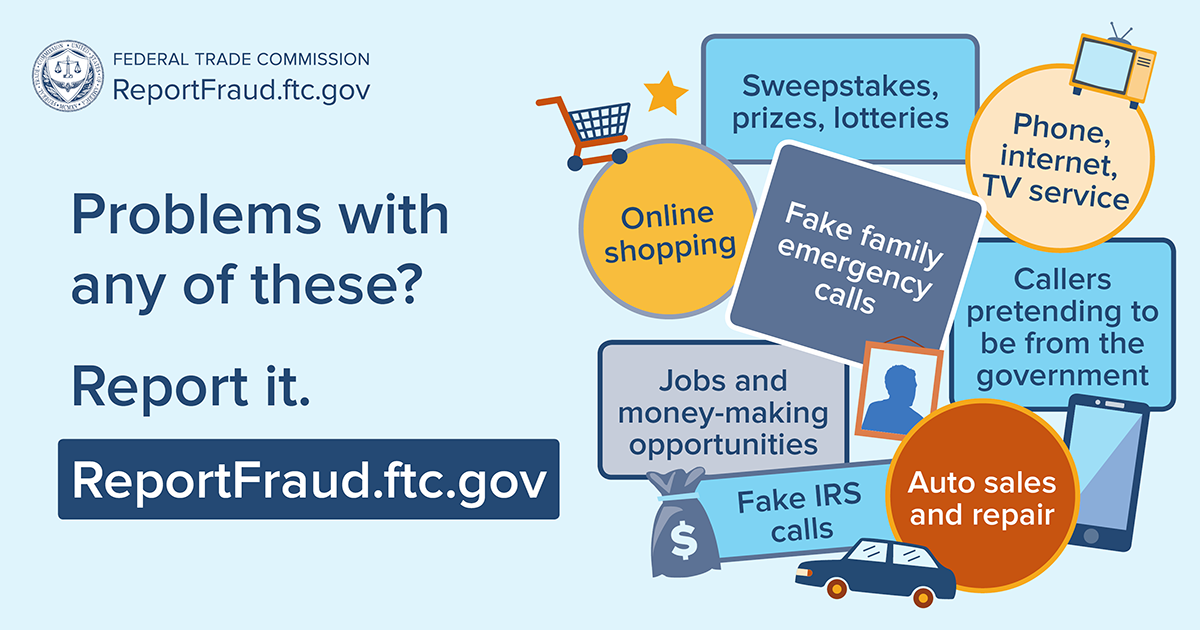
FTC Announces New Fraud Reporting Platform for Consumers: ReportFraud.ftc.gov

At ReportFraud.ftc.gov, consumers will find a streamlined and user-friendly way to submit reports to the FTC about scams, frauds, and bad business practices. The FTC has long encouraged consumers to report these issues to the FTC when they encounter them—whether or not they lost money to the fraud.

Visit ReportFraud.FTC.gov

“Every time you report scams or bad business practices to the FTC, you’re helping to protect your community,” said Andrew Smith, Director of the FTC’s Bureau of Consumer Protection. “With ReportFraud.ftc.gov, it’s quicker and easier than ever to share your story, and each report helps the FTC, and other federal, state, and local law enforcement agencies, fight fraud.”

One new feature of the site is that consumers who file a report will receive next steps from the FTC with advice on what to do based on their particular report. The FTC has more information available for consumers, including a new video explaining how the site works.

The site takes the place of the FTC Complaint Assistant, and consumers visiting that site will be redirected to ReportFraud.ftc.gov to share their information. The site is also in Spanish at ReporteFraude.ftc.gov.

The Federal Trade Commission works to promote competition, and protect and educate consumers. You can learn more about consumer topics and file a fraud report online or by calling 1-877-FTC-HELP (382-4357).

Tuesday, October 6, 2020

FTC Adds Seven New Generic Fiber Names

  • On October 6, 2020, the FTC published in the Federal Register (85 FR 63012) Rules and Regulations Under the Textile Fiber Products Identification Act.

    SUMMARY: The Federal Trade Commission (‘‘FTC’’ or ‘‘Commission’’) amends the Rules and Regulations Under the Textile Fiber Products Identification Act (‘‘Textile Rules’’ or ‘‘Rules’’) to incorporate the most recent ISO 2076 standard for generic fiber names.

    DATES: This rule is effective November 5, 2020. The incorporation by reference of certain publications listed in the rule is approved by the Director of the Federal Register as of November 5, 2020.

    In a Notice of Proposed Rulemaking (‘‘NPRM’’) published on February 18, 2020 (85 FR 8781),the Commission proposed amending § 303.7 to incorporate the most recent version of the relevant ISO standard, ISO 2076:2013(E), ‘‘Textiles— Man-made fibres—Generic names.’’ This standard includes seven generic fiber names that are not defined in the currently-incorporated 2010 ISO standard:

    • ‘‘chitin,’’
    • ‘‘ceramic,’’
    • ‘‘polybenzimidazol,’’
    • ‘‘polycarbamide,’’
    • ‘‘polypropylene/polyamide bicomponent,’’
    • ‘‘protein,’’ and
    • ‘‘trivinyl.’’
  • Tuesday, June 16, 2020

    AAFA Calls for Changes to Apparel Label Requirement to Allow Digital Labels

    The American Apparel and Footwear Association has proposed to the U.S. Federal Trade Commission a regulatory update the apparel, footwear, and travel goods labeling rules to provide "flexible to accommodate new methods of conveying information, especially using digital labels to address the shortcomings of physical markings. We think that the future of apparel labeling will take the shape of a QR code, human-readable URL, other scanning technology, or some combination of these technologies printed on or embedded in a label."

    The proposal is available online HERE

    Tuesday, February 18, 2020

    Federal Trade Commission Proposes to Add Seven New Generic Fiber Names

    On February 18, 2020, the FTC published in the Federal Register (85 FR 8781) Rules and Regulations Under the Textile Fiber Products Identification Act

    SUMMARY: The Federal Trade Commission (``FTC'' or ``Commission'') proposes amending the Rules and Regulations under the Textile Fiber Products Identification Act (``Textile Rules'' or ``Rules'') to incorporate the most recent ISO 2076 standard for generic fiber names. The proposed amendment should reduce compliance costs and increase flexibility for firms providing textile fiber information to consumers.

    DATES: Written comments must be received on or before March 19, 2020.

    The Commission proposes to incorporate the most recent version of the relevant standard, ISO 2076:2013(E), ``Textiles--Man-made fibres--Generic names,'' Sixth edition, November 15, 2013 (ISO 2076:2013(E)), in Sec. 303.7 of the Textile Rule. The updated 2013 standard adds seven generic fiber names not defined in the 2010 standard: ``Chitin,'' ``ceramic,'' ``polybenzimidazol,'' ``polycarbamide,'' ``polypropylene/polyamide bicomponent,'' ``protein,'' and ``trivinyl.''

    Commission staff has received several inquiries from manufacturers interested in initiating a proceeding to amend the Commission's list of approved generic fiber names under 16 CFR 303.8 to add ``chitin,'' a name recognized in ISO 2076:2013(E). Therefore, incorporating that standard into the Textile Rules will resolve the current requests, save the Commission and the manufacturers resources, and harmonize the two standards without the need to address other ISO recognized names individually.

    Tuesday, January 14, 2020

    FTC Publishes Inflation-Adjusted Fines for Violations of the Textile and Wool Acts

    On January 14, 2020, the Federal Trade Commission published in the Federal Register (85 FR 2014) Adjustments to Civil Penalty Amounts

    The Federal Trade Commission ("FTC" or "Commission") is implementing adjustments to the civil penalty amounts within its jurisdiction to account for inflation, as required by law.

    The following adjusted amounts will take effect on January 14, 2020:

    • Section 5(l) of the FTC Act, 15 U.S.C. 45(l) (unfair or deceptive acts or practices)--Increase from $42,530 to $43,280;
    • Section 5(m)(1)(A) of the FTC Act, 15 U.S.C. 45(m)(1)(A) (unfair or deceptive acts or practices)--Increase from $42,530 to $43,280;
    • Section 5(m)(1)(B) of the FTC Act, 15 U.S.C. 45(m)(1)(B) (unfair or deceptive acts or practices)--Increase from $42,530 to $43,280;
    • Section 10 of the FTC Act, 15 U.S.C. 50 (failure to file required reports)--Increase from $559 to $569;
    • Section 6(b) of the Wool Products Labeling Act, 15 U.S.C. 68d(b) (failure by wool manufacturers to maintain required records)--Increase from $559 to $569;
    • Section 3(e) of the Fur Products Labeling Act, 15 U.S.C. 69a(e) (failure to maintain required records regarding fur products)--Increase from $559 to $569;
    • Section 8(d)(2) of the Fur Products Labeling Act, 15 U.S.C. 69f(d)(2) (failure to maintain required records regarding fur products)--Increase from $559 to $569;

    Friday, December 20, 2019

    Customs Back off Controversial Proposal for Classification of Certain Textile Blends

    In the December 11, 2019, Customs Bulletin (Vol. 53, No. 45 starting on page 21), CBP announced it will not implement a proposed change to decades-long interpretation of the tariff classification in the case of certain textile products of a 50/50 blend of two types of fibers. Commenters argued that the proposed revocation was contrary to the sound interpretation of the HTSUS.

    For more background read Agathon Associations May 1, 2019 blog.

    Wednesday, May 1, 2019

    Customs Proposed Change to Classification of Certain Garments

    Customs and Border Protection is proposing a change to how certain apparel articles are classified that could substantially increase import duties on these articles. The change relates to garments containing two textile fibers present in equal amounts, i.e., 50/50 blends. Textile articles are classified according to the chief weight fiber in the article. If no one fiber predominates, as in a 50/50 blend there are two classifications that equally describe the article, the rule used to choose which of the two to use is to use the classification that comes last in numeric order. For example in the past CBP made the following rulings --
    • Men's shorts of 50% linen and 50% rayon could be classified at 6203.43.80 (other textile materials) with rate of duty of 27.9% or 6203.49.80 (synthetic) with rate of duty of 2.8%, CBP classified at 6203.49.80, with rate of duty of 2.8%.
    • Men's shirts of 50% linen and 50% rayon could be classified at 6205.30.20 (man-made fiber) with rate of duty of 29.1 center/kg + 25.9% or 6205.90.40 (other textile materials) with rate of duty of 2.8%, CBP classified at 6205.90.40, with rate of duty of 2.8%.
    • Men's sweater of 50% cotton and 50% silk could be classified at 6110.20.20 (cotton) with rate of duty of 16.5% or 6110.90.90 (other textile materials) with rate of duty of 6%, CBP classified at 6110.90.90, with rate of duty of 6%.
    • A knit tunic of 50% wool and 50% silk could be classified at 6110.11.00 (wool) with rate of duty of 16% or 6110.90.00 (other textile materials) with rate of duty of 6%, CBP classified at 6110.90.90, with rate of duty of 6%.

    In each case CBP ruled for the classification that came numerically last within the subheading that described the article.

    Now CBP has taken a fresh look at the General Rules of Interpretation and is proposing to reverse those rulings and change the way articles of 50/50 composition are classified.

    Here are the relevant rules

    Note 2 (A) to Section XI, HTSUS, provides: Goods classifiable in chapters 50 to 55 or in heading 5809 or 5902 and of a mixture of two or more textile materials are to be classified as if consisting wholly of that one textile material which predominates by weight over each other single textile material. When no one textile material predominates by weight, the goods are to be classified as if consisting wholly of that one textile material which is covered by the heading which occurs last in numerical order among those which equally merit consideration.

    * * *

    Subheading Note 2 (A) to Section XI, HTSUS, provides: Products of chapters 56 to 63 containing two or more textile materials are to be regarded as consisting wholly of that textile material which would be selected under note 2 to this section for the classification of a product of chapters 50 to 55 or of heading 5809 consisting of the same textile materials.

    READ MORE

    To see the CBP proposal Click HERE

    It is now CBP's position that an apparel article of 50/50 composition be classified according to which fabric classification comes last numerically. So, in the case of the linen (Chapter 53) / rayon (Chapter 54 or 55) blend, they classify as rayon. In the case of silk (Chapter 30) / Cotton (Chapter 52) they classify as cotton. In the case of silk (Chapter 50) / wool (Chapter 51) they classify as wool.

    The result of this change is that in each of the cases above, and similar ones, the higher duty will apply.

    Note this change affects classification of apparel and home textiles of 50/50 blends. It does not affect the classification of fiber, yarn, or fabric.

    AGATHON ASSOCIATES NOTES

    1. Even if these proposed change goes through, they still have the wrong classification in the case of the linen/rayon shorts. Under this proposed way of classifying, they would be at 6203.49.05 for artificial fiber, not 6203.43.90 (synthetic). The rate of duty is the same either way, 27.9%

    2. This is why Agathon Associates always discourages clients from importing goods of 50/50 blend of two textile fibers. Aside from this proposed change in classification, it is a bad idea. A small inadvertent variance in the manufacturing process can easily shift your goods from the expected classification to another classification that could affect the rate of duty. Such inadvertent variance could also result in the content of the goods not agreeing with the product labeling, which is a violation of the Federal Trade Commission labeling laws.

    Monday, January 29, 2018

    CCMI launches Fiber Box 2

    CCMI announces the launch of Fiber Box 2.

    Fiber Box 2 contains 24 samples of animal fibers including Cashmere, Yak, Camel Hair and Qiviut.

    In many cases, animal fibers are chemically treated in dyeing, bleaching and other processes. Morphological features of fibers may change in these processes. Also, DNA and protein in the fibers are affected by heat and chemicals. Fibers are sometimes chemically treated to add particular characteristics. Changes in surface morphology and protein damage caused by chemical treatment may make identifying and distinguishing different animal fibres more difficult. Therefore, it is important for fiber analysts to understand the modification of fibers caused by chemical processing, whether the analyst applies microscopic methods or alternative methods such as protein and DNA analysis.

    Fiber Box 2 contains natural (unprocessed) fibers and treated fibers from the same lots to provide analysts with useful information on changes caused by processing.

    Fiber Box 2 also contains samples of genuine South American Camelids (Alpaca and Llama) and Qiviuk (Must ox hair).

    The CCMI Fiber Box 2 will sell for 1,000 USD (One Thousand U.S. Dollars). The price includes freight to the destination but does not include the import duty of the importing country. The box will be sent by courier upon receipt of payment. Any questions please contact Jane Lomas of the Boston office at jlomas@cashmere.org.

    Monday, January 22, 2018

    2018 Penalties for Violations of Wool Rules Increased

    On January 22, 2018, the Federal Trade Commission published in the Federal Register (83 FR 2902) Adjustments to Civil Penalty Amounts. Among the penalties being adjusted update for inflation are the penalties for violations of the Wool Products Labeling Act of 1939.

    Monday, January 15, 2018

    WOOL RULES: Agency Information Collection Activities; Proposed Collection; Comment Request.

    On January 16, 2018, the Federal Trade Commission published in the Federal Register (83 FR 2154) Agency Information Collection Activities; Proposed Collection; Comment Request.

    The Wool Products Labeling Act of 1939 ("Wool Act") prohibits the misbranding of wool products. The Wool Rules establish disclosure requirements that assist consumers in making informed purchasing decisions and recordkeeping requirements that assist the Commission in enforcing the Rules.

    Estimated Annual Hours Burden: 1,880,000 hours (160,000 recordkeeping hours + 1,720,000 disclosure hours). Recordkeeping: Staff estimates that approximately 4,000 wool firms are subject to the Wool Rules’ recordkeeping requirements. Based on an average annual burden of 40 hours per firm, the total recordkeeping burden is 160,000 hours.

    Disclosure: Approximately 8,000 wool firms, producing or importing about 600,000,000 wool products annually, are subject to the Wool Rules’ disclosure requirements. Staff estimates the burden of determining label content to be 30 hours per year per firm, or a total of 240,000 hours, and the burden of drafting and ordering labels to be 60 hours per firm per year, or a total of 480,000 hours. Staff believes that the process of attaching labels is now fully automated and integrated into other production steps for about 40 percent of all affected products. For the remaining 360,000,000 items (60 percent of 600,000,000), the process is semiautomated and requires an average of approximately ten seconds per item, for a total of 1,000,000 hours per year. Thus, the total estimated annual burden for all firms is 1,720,000 hours (240,000 hours for determining label content + 480,000 hours to draft and order labels + 1,000,000 hours to attach labels). Staff believes that any additional burden associated with advertising disclosure requirements would be minimal (less than 10,000 hours) and can be subsumed within the burden estimates set forth above.

    Estimated Annual Cost Burden: $16,380,000, rounded to the nearest thousand (solely relating to labor costs)

    DATES: Comments must be received on or before March 19, 2018.

    Friday, October 14, 2016

    Edinburgh Woollen Mill in Court over 'Pure Cashmere' Mislabelling

    Following a tip from the Cashmere and Camel Hair Manufacturers Institute, Scottish officials arranged for independent laboratory analysis of textile products sold at Edinburgh Woollen Mill and labeled as 100% cashmere. The laboratory analysis contradicted the labeling claim, and the business is now facing a court case in Scotland over mislabeling. Read more at www.theguardian.com.

    Wednesday, December 9, 2015

    Major Retailers Hit with $1.3 Million Fee for False Claims of "Bamboo" Fiber

    The Federal Trade Commission announced complaints and proposed court orders barring four national retailers from mislabeling and advertising rayon textiles as made of “bamboo,” and requiring them to pay civil penalties totaling $1.3 million.

    Under the court orders settling the FTC’s charges, Bed Bath & Beyond Inc. will pay $500,000; Nordstrom, Inc. will pay $360,000; J.C. Penney Company, Inc. will pay $290,000; and Backcountry.com LLC will pay $150,000 for allegedly violating the FTC Act and the agency’s Textile Rules.

    “It’s misleading to call bamboo that has been chemically processed into rayon simply ‘bamboo,’” said Jessica Rich, Director of the Bureau of Consumer Protection. “With consumers in the midst of their holiday shopping, it’s important for them to know that textiles marketed as environmentally friendly alternatives may not be as ‘green’ as they were led to believe.”

    The complaints announced today allege the four companies broke the law by continuing to misrepresent or mislabel rayon products as “bamboo” despite receiving warning letters from the FTC in 2010 and a synopsis of previous litigated cases against marketers for deceptively labeling rayon products as bamboo. The Commission charged the companies with violating the Textile Act and the Textile Rules and with violating Section 5(m)(1)(B) of the FTC Act by falsely and deceptively selling the mislabeled products, despite knowing that doing so was illegal and could subject them to civil penalties.

    Specifically, Bed Bath & Beyond’s mislabeled items, also sold through its subsidiary buybuy BABY, included dozens of “bamboo” textiles, including “Aden + Anais Bamboo 3-Pack Muslin Swaddles” and “Bamboo Blend Napkins.”

    Nordstrom sold similar products online and in its stores, including a “Gypsy 05 Bamboo Racerback Hi-Lo Dress” and “Degree Six Clothing The Bamboo Long Sleeve Tee.”

    J.C. Penney sold numerous “bamboo” products in its stores and online, including “Muk Luks 4-pk Men’s Bamboo Socks.” It also falsely claimed “bamboo” gave the products antimicrobial properties.

    Similarly, Backcountry.com sold “bamboo” textiles, such as “Bridgedale Bamboo Crew Sock – Men’s.” Backcountry also made anti-microbial claims for its “bamboo” products.

    The proposed orders settling the FTC’s charges are identical, aside from the civil penalty amounts. They prohibit the companies from violating the FTC’s Textile Act and Rules by failing to properly identify the fiber content when labeling and advertising any textiles containing manufactured fibers.

    The FTC press release is available at https://www.ftc.gov/news-events/press-releases/2015/12/nordstrom-bed-bath-beyond-backcountrycom-jc-penny-pay-penalties?utm_source=govdelivery

    Tuesday, February 17, 2015

    Happy Year of the Goat

    Thursday, February 19, 2015, on the Gregorian Calendar, is the beginning of the lunar new year, sometimes called Chinese New Year, and observed in many of the nations of East and Southeast Asia.


    If you are looking to a new year's gift, you couldn't go wrong with...
    ...an apparel article, such as these scarves, made of 100 percent hair of the CASHMERE GOAT.


                Are your yarns, fabrics, apparel, or home textile articles labeled in compliance with the Federal Trade Commission ("FTC") Wool Rules and Textile Rules?
                Are you sure?
                David Trumbull, Principal, Agathon Associates, has 20-years experience working with the FTC. We can assist you with LABEL ADVISOR, which offers "Smart guidance for U.S. label compliance: SO SMART, SEW RIGHT." Contact David at 202-657-6008 or david@agathonassociates.com.
                Federal Trade Commission requirement for labeling of textile and apparel products are complex and cover such areas as:
    Ø      country of origin,
    Ø      fiber content,
    Ø      care labeling, and
    Ø      identification of manufacturer, importer, or other dealer.
                The penalties for mislabeling can be high, in some cases as high as $16,000 per offense (that's per skein of yarn, roll of fabric, garment, or home textile article!).
    Do you know the answers to these questions? Are you sure?
    Q.        Recently four national retailers agreed to pay FTC penalties totaling $1.26 million for labeling rayon made from bamboo as simply "bamboo." Are your bamboo products labeled in compliance with the FTC regulations?
    Q.        What is the FTC one step removed rule for country of origin labeling and how does it apply to your product?
    Q.        Why is it not permissible in the U.S. to label the fiber content of a yarn, fabric, apparel or home textile article as "pashmina?"
    Q.        Are you aware of, and in compliance with the FTC's new definition of cashmere, which was part of the July 2014 modifications to the Wool Rules? What about the changes made at that time to the designation of very fine wools?
    Q.        Did you know that natural fibers such as wool and cotton are not necessarily organic and that the FTC has provided guidance that broad, unqualified general environmental benefit claims like "green" or "eco-friendly" are not acceptable?
    For help with labeling requirements Contact David at 202-657-6008 or david@agathonassociates.com.